












"Take your Fiido C11 Pro on holiday to the beach! It was easy to ride with a bike trailer fully packed with beach gear and two kids attached."
Christian Wohlgemuth

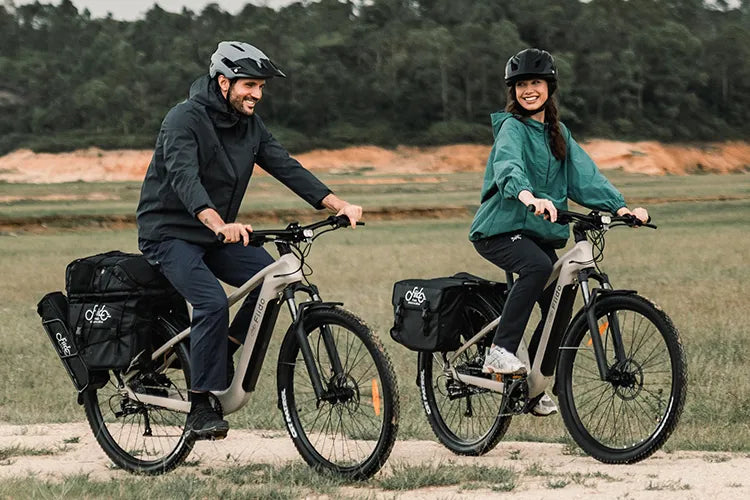
Discover fat tire E-Bikes collection with big tire (20"-26" × 4 inch), up to an unbeatable 215-mile range, 441 lbs payload, or just 54.5 lbs lightweight. Designed for smooth, all-weather family adventures with cargo, experience ultimate stability from city streets to rugged trails.
Fiido proudly presents the Cargo&Commute Series—your ultimate companion for family adventures, long-distance journeys, and all-terrain explorations. Designed with versatility in mind, these e-bikes offer everything needed for a seamless ride.
Equipped with long-range batteries and powerful motors, including options like the fat tire electric bike 1000w and 750w fat tire electric bike, the Cargo&Commute Series ensures you won’t run out of power, even on extended trips. If you’re searching for a cheap electric fat tire bike that doesn’t compromise on performance, this series is ideal.
Built for durability and stability, these wide tire electric bikes feature maintenance-free, one-piece wheels that handle any terrain with ease, from rugged trails to city streets. You may ask, are there Fiido fat tire electric bikes for sale near me? Fiido has you covered with our authorized physical stores. Come and try them out!
What sets the Cargo&Commute Series apart is its exceptional load capacity, making it the top choice for busy parents and adventurers. Say goodbye to multiple trips and enjoy the convenience of carrying everything you need in one go.
At Fiido, reliability and versatility are key. Our Cargo&Commute Series exceeds expectations, delivering unmatched performance and comfort on every journey. Whether commuting or exploring, trust Fiido to get you there in style. For expert insights, check out our fat tire electric bike reviews and discover what are the best fat tire electric bikes. Plus, explore our models designed specifically as women's fat tire electric bikes.
Experience unparalleled convenience and freedom with the Fiido T2 eBike. Engineered to excel in every aspect, it offers unmatched long-range capabilities, powered by a robust motor and a high-capacity 998Wh battery. Say goodbye to range anxiety and embrace worry-free extended rides.
But the Fiido T2 is more than just a mode of transportation; it's a versatile companion tailored to meet your diverse needs. Whether it's navigating through bustling city streets during your daily commute, effortlessly cruising through grocery runs, or conveniently picking up your children from school, the Fiido T2 effortlessly adapts to every scenario.
Its multi-functional design ensures seamless integration into various aspects of your life. Need to make quick deliveries? The Fiido T2 is up to the task, providing efficient and reliable transportation solutions.
With its sleek and modern aesthetics, advanced technology, and ease of maintenance, the Fiido T2 eBike is not just a mode of transportation; it's a lifestyle choice. Join the revolution in urban mobility and experience the ultimate in convenience and versatility with the Fiido T2.
Following the widespread acclaim of the Fiido X, we turned our focus towards the mountain biking market. Recognizing the desires of many cycling enthusiasts to explore outdoor adventures, we proudly introduce the T1 PRO—an innovative solution tailored for both urban commuting and mountain biking needs.
The Fiido T1 PRO stands as your ultimate companion for mountain adventures. Equipped with a massive 960Wh battery, it offers an impressive range of up to 93 miles, allowing you to effortlessly explore diverse terrains. Powered by a 750w brushless motor with throttle control, it propels you to thrilling speeds of up to 28 MPH, ensuring endless excitement and uninterrupted fun.
Designed for rugged performance, the T1 PRO offers unparalleled stability and reliability. With robust magnesium alloy one-piece wheels and an aluminum alloy frame, it supports a maximum weight of 440 lbs. Its innovative weight distribution design grants the riding seat a carrying capacity of 264 lbs, with an additional 176 lbs capacity for the rear rack. Furthermore, the 20""*4.0 all-terrain fat tires ensure smooth traversal even on the most challenging trails.
More than just an electric bike, the Fiido T1 PRO is your ultimate outdoor adventure companion. Whether you're exploring the mountains or venturing into the wilderness, the T1 PRO stands by your side, offering unprecedented exploration experiences and endless thrills.
Tires CST 20×4.0 Inch, net weight 26.8 kg, maximum load 120 kg, aluminum alloy frame, front hydraulic coil-spring suspension (60 mm travel) + rear coil suspension, SHIMANO 7-speed drivetrain, hydraulic disc brakes with power cut-off, electric-assist range approximately 88.8 km, torque 55 N·m. This foldable mountain-style fat tire e-bike is lightweight and versatile. Its folding design makes it easy to carry and store, and the combination of suspension and fat tires provides comfortable grip and stable handling for urban commuting and light off-road riding, making it ideal for short trips and leisure adventures.
Non-foldable, tires 26×4.0 Inch, net weight 37.8 kg, maximum load 200 kg (rider seat 120 kg + rear rack 80 kg), aluminum alloy frame, front hydraulic coil-spring suspension (60 mm travel), S‑RIDE 9-speed drivetrain, four-piston hydraulic disc brakes with power cut-off, single battery range 115 km, triple battery maximum range 347 km, torque 55 N·m. This all-terrain fat tire e-bike offers exceptional traction, high load capacity, and long-range performance. With powerful torque and four-piston hydraulic brakes, it handles sand, snow, mud, and other challenging terrains with ease. It's perfect for long-distance adventures and extreme off-road riding.
A fat tire e-bike is an electric bicycle equipped with extra-wide tires—typically measuring 4.0 inches or more—designed to run at lower inflation pressures than standard bicycle tires. This expanded contact patch maximizes traction and stability, allowing the bike to roll more smoothly over soft or loose terrain such as sand, gravel, and snow, where traditional narrow tires are more likely to sink.
Usually paired with higher-torque electric motors to help overcome the increased rolling resistance, fat tire e-bikes offer versatile, all-weather performance across a wide range of environments. Heavy-duty all-terrain models like the Fiido Titan use 26×4.0-inch tires for maximum stability, while versatile designs like the Fiido T2 and folding Fiido M1 Pro use 20×4.0-inch fat tires to balance maneuverability, traction, and multi-surface utility.
Fat tires—typically 4.0 inches or wider—are used on electric bikes to increase traction, surface flotation, and ride comfort. Compared with standard e-bikes, fat tire models offer three distinct advantages:
While standard e-bikes generally prioritize range efficiency and agile handling on smooth pavement, fat tire e-bikes provide greater versatility across changing terrain and weather conditions. Models like the Fiido T2 use 20×4.0-inch tires, allowing the bike to serve as both a heavy-duty urban cargo hauler and a capable option for camping trips, gravel roads, and outdoor excursions.
A fat tire electric bike can be an ideal choice if you regularly need to tackle soft or unpredictable terrain such as deep sand, mud, or snow, or if you frequently transport heavier loads and want additional stability at lower speeds.
Oversized 4.0-inch tires provide extra traction and natural shock absorption on rough surfaces, with heavy-duty models like the Fiido Titan offering strong load stability for rugged conditions, while compact options like the Fiido M1 Pro combine fat tires, suspension, and a folding frame for more portable off-road use.
However, if your daily routes consist almost entirely of smooth city pavement and you prioritize a lighter bike, quicker handling, and maximum battery efficiency, a standard narrow-tire e-bike is likely to remain the more practical choice.
Fat tires are better if your primary riding goals are maximum traction, off-road stability, and comfort on rough surfaces, but they are not universally superior for every rider.
Extra-wide 4.0-inch tires perform particularly well on soft or uneven terrain such as sand, mud, loose gravel, and snow by distributing weight over a larger contact patch and absorbing surface vibrations at lower inflation pressures.
However, the additional contact area also creates greater rolling resistance and adds rotating mass, which requires more energy from the motor and can reduce battery efficiency compared with standard narrow tires.
Fat tires are particularly useful for all-weather riding, heavy-duty hauling, and off-road exploration, while narrower road and commuter tires remain better suited to riders who prioritize efficiency, lower weight, and agile handling on smooth pavement.
The best fat tire electric bikes combine high-torque motors, durable frame designs, reliable braking systems, and wide 4.0-inch tires to provide enhanced traction and stability on challenging surfaces such as sand, snow, mud, gravel, and rough trails. Beyond tire width, a high-quality fat tire e-bike should also offer suitable battery capacity, dependable components, and a frame design that matches its intended use.
The right choice depends on how and where you ride. Off-road riders and outdoor explorers may prioritize traction, suspension, and portability, making a folding model like the Fiido M1 Pro a suitable option. Long-distance adventure riders who need maximum range and all-terrain capability may prefer a full-size model like the Fiido Titan. Cargo-focused riders and families transporting heavier loads may benefit more from a stable, low-center-of-gravity design such as the Fiido T2.
The biggest difference between 20-inch and 26-inch fat tire e-bikes is how they balance maneuverability and stability. Smaller 20-inch wheels are generally more compact, agile, and easier to control at lower speeds, while larger 26-inch wheels provide better rollover capability, smoother momentum, and greater stability across longer distances and rough terrain.
In simple terms, choose a 20-inch fat tire e-bike if you need tighter maneuverability, a lower center of gravity for cargo stability, and easier storage. For example, the Fiido M1 Pro combines 20×4.0-inch tires with a folding frame and suspension system for portable off-road capability.
Choose a 26-inch fat tire e-bike if you prioritize stability, obstacle rollover, and long-distance trail performance. Models like the Fiido Titan use 26×4.0-inch tires to roll more easily over deep ruts, rocks, and rough backcountry terrain, while its three-battery configuration can provide up to approximately 215 miles (347 km) of extended range.
Tire size indicates an e-bike wheel's diameter and width—for example, 20×4.0 inches or 27.5×2.1 inches—which directly affects how the bike rolls, absorbs impacts, and grips different surfaces.
In 2026, under normal riding conditions, most standard fat tire e-bikes provide a real-world range of approximately 30–60 miles (50–100 km) per charge, while some heavy-duty touring models can reach around 90 miles (150 km) or more depending on their battery systems and riding conditions.
For riders who need maximum distance, the Fiido Titan stands out as a particularly long-range fat tire e-bike. With its three-battery expansion system, it can deliver up to approximately 215 miles (347 km) in its extended configuration.
Combined with 26×4.0-inch tires, high payload capacity, and a touring-focused design, the Titan is designed for multi-day adventures, long-distance cargo hauling, and demanding all-terrain riding where additional range can be especially valuable.
Choosing the best fat tire e-bike depends on your terrain, riding purpose, storage limitations, and cargo requirements. Key factors to consider include:
For example, the Fiido M1 Pro suits riders who want a portable folding fat tire e-bike for off-road recreation, while full-size utility models like the Fiido Titan for long-distance all-terrain riding and the Fiido T2 for stable heavy hauling are better suited to demanding utility needs.
Yes. A fat tire e-bike can be particularly well suited to hunting, camping, and outdoor adventures because its wide tires, strong traction, and stable handling allow it to navigate uneven terrain such as dirt trails, gravel roads, mud, sand, and forest paths.
Compared with standard e-bikes, fat tire models generally provide better control on loose surfaces and can offer greater stability when carrying additional equipment.
For outdoor use, look for features such as long battery range, sufficient motor torque, puncture-resistant tires, suspension, and cargo capacity to support longer distances and heavier gear.
For example, the Fiido Titan is designed for long-range all-terrain riding with 26×4.0-inch fat tires, high payload capacity, and extended battery options, making it suitable for riders who need additional range and utility for camping trips, outdoor exploration, hunting access routes, and transporting equipment.
The main difference is tire width, which affects terrain capability, comfort, handling, and riding efficiency.
Fat tire e-bikes typically use tires around 3.8–4.5 inches wide and can often be operated at lower tire pressures, providing better traction, stability, and vibration absorption on surfaces such as sand, snow, mud, gravel, and rough trails.
Regular e-bikes generally use narrower tires, often around 1.5–2.2 inches, which create less rolling resistance, provide lighter handling, and offer greater efficiency for everyday riding on smooth pavement.
The better choice therefore depends on whether you prioritize all-terrain traction and stability or lighter weight and pavement efficiency.
Fat tire e-bikes perform particularly well on unpredictable, loose, and rough surfaces where standard narrow tires may be more likely to sink or lose grip. These conditions can include deep sand, snow, mud, loose gravel, and rugged off-road trails.
Their wide 4.0-inch tire footprint distributes weight over a larger surface area, helping the bike stay on top of softer ground, while lower tire pressures can improve traction and comfort on slippery or uneven terrain.
Fat tire e-bikes can also be useful on poorly maintained urban streets by helping absorb potholes, cracks, and broken pavement. Utility models like the Fiido T2 use wide fat tires designed to provide additional stability and durability when carrying heavier loads across changing road surfaces.
An all-terrain fat tire electric bike can generally handle sand, snow, gravel, and off-road trails better than a standard narrow-tire e-bike because its wide 4.0-inch tires provide greater traction, stability, and flotation on loose or uneven surfaces.
The larger contact patch helps distribute the combined weight of the rider and bike more evenly, reducing how easily the tires sink into softer terrain while helping maintain better control on dirt paths, gravel roads, and packed snow.
Actual performance still depends on factors such as motor torque, battery capacity, tire pressure, suspension, rider weight, and the specific terrain conditions.
For example, the Fiido Titan uses 26×4.0-inch fat tires together with strong motor assistance to provide the stability and power needed for demanding outdoor riding and heavy-duty utility use.
Yes. A fat tire electric bike can certainly be ridden on smooth pavement, although the riding experience is different from that of a traditional road bike or city commuter e-bike.
The wider tires provide additional stability, comfort, and grip, which can be particularly useful on cracked roads, potholes, wet pavement, or poorly maintained streets.
The trade-off is that fat tires create more rolling resistance and generally add weight compared with narrower commuter tires. This can reduce efficiency somewhat and make the bike feel less agile on smooth pavement.
For riders who want one e-bike capable of handling both paved roads and occasional off-road surfaces, a fat tire e-bike provides greater versatility. However, if almost all of your riding takes place on smooth pavement and you prioritize maximum efficiency, lower weight, and quick handling, a standard commuter e-bike may be the better option.
Yes. You can ride a fat tire e-bike in the rain if you follow appropriate wet-weather riding practices, as explained in this guide: How to Ride an E-Bike in the Rain.
Wide 4.0-inch tires provide a larger contact patch, which can help improve stability and traction on wet pavement, slippery road surfaces, and muddy trails compared with narrower tires.
Many modern e-bikes use water-resistant electrical components designed to handle normal rain and road spray, but this does not mean that they are completely waterproof or safe to submerge in deep water.
For better safety and long-term durability, use full-coverage fenders to reduce road spray, ride at a controlled speed in wet conditions, avoid deep standing water, and clean and dry important components after rainy rides.
Fat tire e-bikes can feel somewhat heavier to pedal or maneuver than regular e-bikes because their wider tires, stronger frames, and larger components add both weight and rolling resistance.
However, when electric motor assistance is engaged, most riders find that the difference becomes much less noticeable during normal everyday riding.
The trade-off is that fat tires provide greater stability, comfort, and traction, especially on uneven roads, gravel, sand, snow, or when carrying heavier loads.
For riders who prioritize versatility, stability, and confidence across different surfaces over having the lightest possible bicycle, the additional weight is often a worthwhile compromise.
The additional weight of fat tires and larger components can increase rolling resistance and energy consumption compared with standard e-bikes, meaning the motor may need to work harder—particularly during acceleration, climbing, or riding on soft terrain.
However, the impact on range depends on much more than tire size alone. Battery capacity, motor efficiency, assistance mode, terrain, tire pressure, rider weight, cargo load, wind, and temperature can all significantly affect real-world range.
This is why long-range fat tire e-bikes often use larger battery systems rather than relying only on a more powerful motor. The Fiido Titan addresses this challenge with a three-battery expansion structure, providing up to approximately 215 miles (347 km) of range in its extended configuration.
Its design is aimed at riders who need extended-distance capability for touring, outdoor adventures, long trips, and heavy-duty utility riding.


